

SONATA NO.3 BALLADE FOR SOLO VIOLINE
by Eugene Ysaye
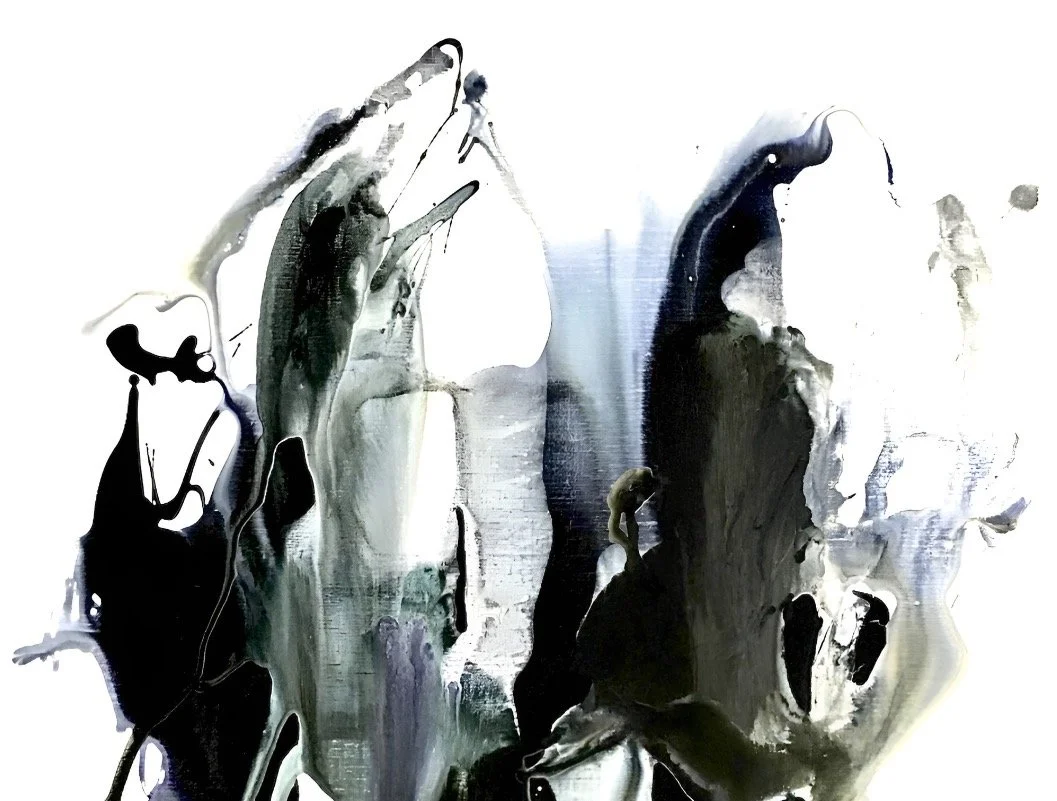
Sonata No.3, Acylic on canvas, 200 X 80cm, 2016
Music has the power to collapse time and space. Yet it cannot be held. It completely fills the present moment, and at the same time, it is constantly disappearing. The instant a note resounds, it has already become a trace of the past. Music exists only within the flow of time.
Painting is different. The paint that remains on the canvas stays in place, holding within it the movement of time. The image I saw yesterday remains the same today. For this reason, I often liken music to “flowing time,” and painting to a “body at rest.”
Sonata No. 3 from the Sound Series was an experiment in capturing an invisible moment of emotion. I did not attempt to reproduce the music itself, but rather to record the tremor of that moment as traces of paint.
Ultimately, this work explores the point at which still time and flowing time meet. The painting becomes a space that contains music, and music, in turn, allows time to flow again within the painting.
Bach’s Chaconne: Violin Partita No.02 BWV. 1004
by Hyung-Joon
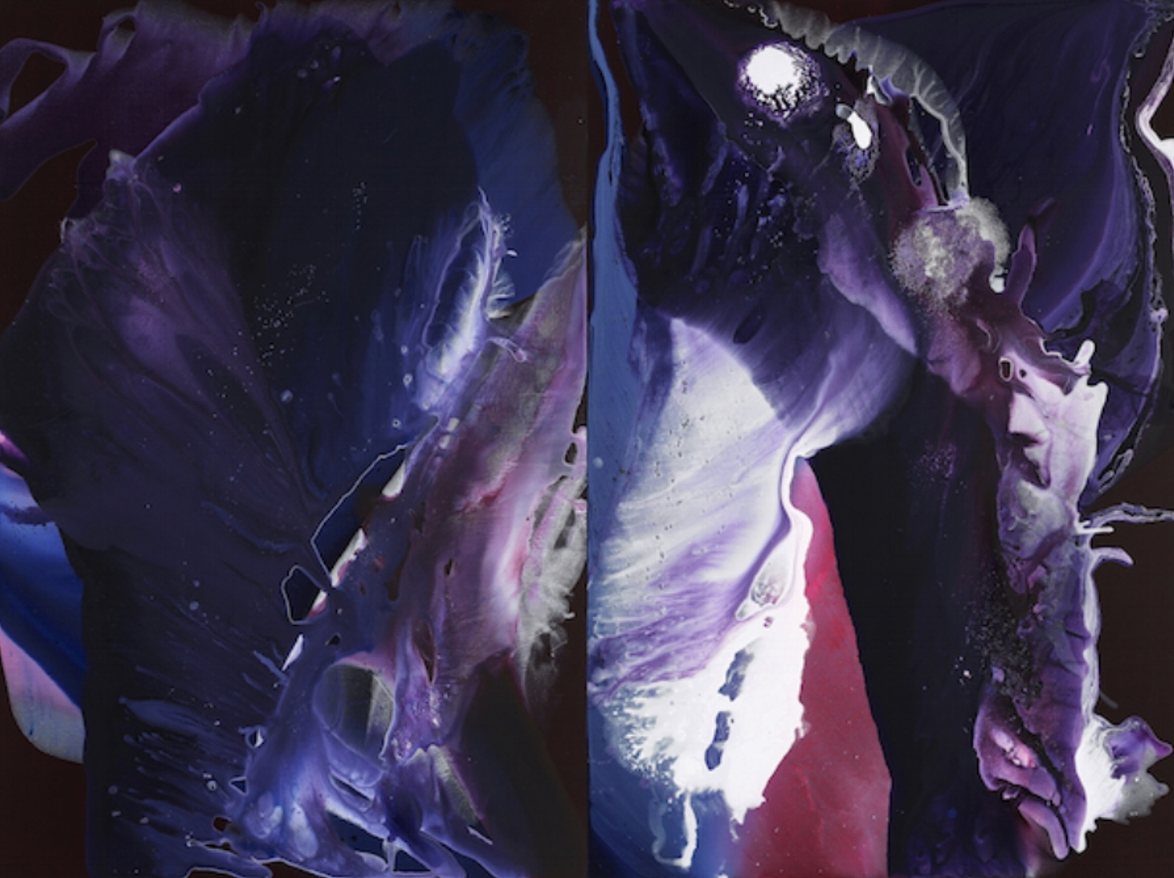
Endless Lingering, Acrylic on canvas, 194 X 260.6cm, 2015
While death of body means the end, that of mind exists in a person’s cognition. It is the power of the great arts that gives comfortable and natural stimulus to human mind for a long time. That’s why we pay attention to the endless resonance of the arts. When we consider life and death as the beginning and the end, there is ever-lasting movement between them. Violinist Hyung-Joon, Won and the writer Gian are showing that art does surely live more than meets the eye, by expressing the movement acoustically (music), behaviorally (dance), and visually (art).
The musical program is Bach’s Chaconne: Violin Partita No.02 BWV. 1004 without instrumental accompaniment. Bach’s Chaconne starts with a single minor cord note as if it draws a stroke. The power calmly presses us like gravity, and it is visualized by the pouring technique. The intro of Chaconne repeats at the end of the music. However, violinist Hyung Joon Won gets rid of the last part of the music to tear down the boundary of the begin- ning and the end. This is to show the endless resonance of the arts, which could only exist in one’s mind. While music is played, GIAN’s video images are also played on the screen, which emphasis on temporality by showing the flow of paints and perpetually moving actions mixed to form an organic shape.
You can appreciate both the images of Gian with Bach’s Chaconne and the completed work of art.